
Author name: aadhilsalim76@gmail.com

content marketing strategy
Uncategorized

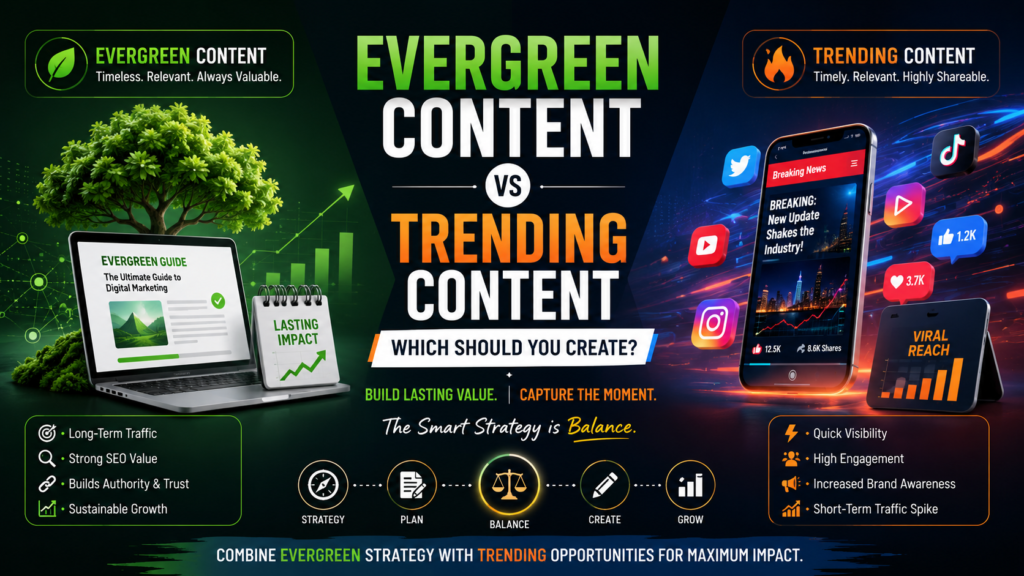
Evergreen Content vs Trending Content: The Ultimate Strategy for Success

1.Introduction: The Content Marketing Strategy Dilemma Every Creator Faces Every content creator, digital marketer, and business owner eventually faces an important question: should you focus on evergreen content or trending content? Both content types play significant roles in a successful content marketing strategy, yet they serve different purposes and produce different outcomes. Consequently, understanding when and how to use each type can significantly improve your website traffic, audience engagement, and long-term online visibility. Moreover, the rise of search engines, social media platforms, and AI-powered content discovery has transformed how audiences consume information. While some articles generate immediate attention because they cover current events or popular topics, others continue attracting visitors for years. Therefore, choosing the right balance between evergreen and trending content has become one of the most valuable decisions in digital marketing. A well-planned content strategy combines both approaches to maximize reach, authority, and sustainable growth. 2.Understanding Evergreen Content: Creating Value That Lasts Evergreen content refers to articles, guides, tutorials, and resources that remain relevant regardless of the date they were published. Unlike time-sensitive posts, evergreen articles answer questions that people consistently search for throughout the year. Consequently, they continue generating organic traffic, backlinks, and reader engagement long after publication. Furthermore, evergreen content serves as the foundation of a successful SEO strategy because search engines favor comprehensive, informative, and timeless resources. Topics such as “What is SEO?How to Start a Blog” and “Digital Marketing Basics” continue to draw readers since the content is still relevant after a long time. Although occasional updates improve accuracy, the core message stays relevant, making evergreen content an excellent long-term investment. 3.Exploring Trending Content: Capturing the Moment Trending content focuses on current events, breaking news, seasonal topics, viral discussions, or newly released products and technologies. Because it addresses what people are actively searching for today, it often generates rapid spikes in website traffic, social media engagement, and online discussions. As a result, businesses frequently use trending content to increase brand visibility and reach new audiences quickly. However, trending content usually has a shorter lifespan than evergreen content. Once public interest fades or new trends emerge, traffic often declines significantly. Nevertheless, when published at the right time, trending articles can attract thousands of visitors within days or even hours. Therefore, marketers who closely monitor industry developments can leverage trending content to gain immediate attention and establish themselves as up-to-date industry experts. 4.The SEO Impact: Which Content Performs Better in Search Engines? Search engine optimization rewards content that satisfies user intent, provides value, and maintains relevance. Evergreen content naturally excels in this area because it continues answering common search queries over time. Consequently, these articles often earn consistent rankings, high-quality backlinks, and steady organic traffic for months or even years after publication. On the other hand, trending content performs exceptionally well during periods of high search demand. When a topic becomes popular, search engines prioritize fresh content that addresses the latest developments. As a result, trending articles can temporarily outrank older pages. However, once the trend disappears, rankings often decline unless the content remains relevant. Therefore, combining evergreen SEO content with timely trending articles creates a more balanced and resilient search strategy. 5.Audience Engagement: Different Content, Different Expectations Readers consume evergreen and trending content for different reasons. Evergreen articles educate, solve problems, and provide lasting knowledge that readers can revisit whenever needed. Consequently, these resources build trust, encourage longer reading sessions, and establish your website as an authoritative source of information. In contrast, trending content satisfies curiosity about current events, viral conversations, or industry changes. Readers expect timely updates, fresh insights, and immediate relevance. Therefore, trending articles often receive higher social media shares, comments, and short-term engagement. While this attention may fade over time, it can introduce your brand to entirely new audiences who later explore your evergreen content. 6.Traffic Patterns: Long-Term Stability vs Immediate Growth One of the biggest differences between evergreen and trending content lies in how they generate website traffic. Evergreen articles typically experience gradual growth as search engines recognize their value and users continue searching for related topics. Although they may not become viral overnight, they often produce reliable traffic for years. Conversely, trending content usually experiences explosive growth immediately after publication. Social media shares, news coverage, and high search volume contribute to sudden traffic spikes. Nevertheless, these peaks rarely last forever. Once public interest shifts elsewhere, visitor numbers decrease significantly. Therefore, businesses should view trending content as a powerful short-term opportunity rather than a permanent traffic source. 7.Content Creation Effort: Planning Versus Speed Creating evergreen content requires detailed research, comprehensive explanations, and careful optimization. Writers must ensure that information remains accurate, well-structured, and valuable for a long time. Consequently, producing high-quality evergreen articles often demands more planning, editing, and SEO optimization before publication. Meanwhile, trending content emphasizes speed without sacrificing accuracy. Since trends change rapidly, content creators must publish while public interest remains high. Therefore, quick research, efficient writing, and fast publishing become essential. Although trending articles may require fewer updates initially, they often become outdated quickly, making them less valuable as long-term assets. 8.When Should You Choose Evergreen Content? Evergreen content is the ideal choice when your primary objective is sustainable organic growth. Businesses seeking consistent search engine traffic, long-term authority, and ongoing lead generation should prioritize evergreen articles. Additionally, educational websites, professional blogs, and service-based businesses benefit significantly from publishing timeless resources that answer frequently asked questions. Moreover, evergreen content strengthens your overall website by creating a reliable knowledge base. Each high-quality article becomes another opportunity for users to discover your brand through search engines. Therefore, investing in evergreen content supports continuous growth while reducing dependence on temporary marketing trends. 9.When Should You Focus on Trending Content? Trending content becomes the better option when your goal is rapid visibility, increased brand awareness, or participation in current conversations. Businesses launching new products, covering industry news, or responding to major events can attract substantial attention through timely content. Furthermore, trending articles perform particularly well on social media platforms where users
Social Media Marketing
Uncategorized

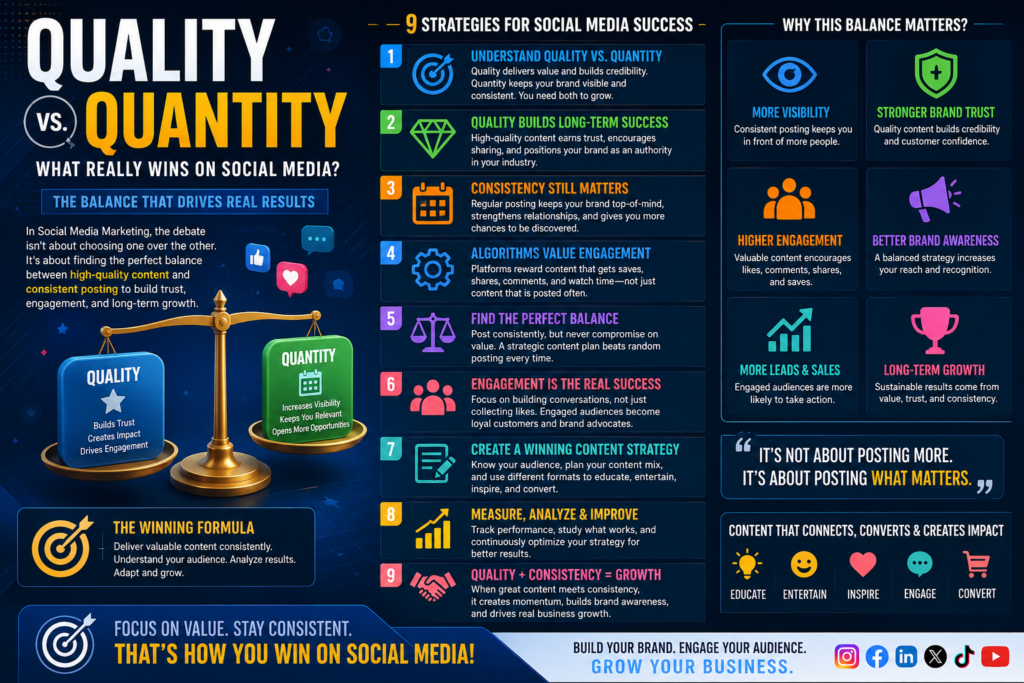
Quality vs. Quantity: What Really Wins on Social Media? | The Ultimate Social Media Marketing Guide

Meta Description:Discover whether quality or quantity truly drives success in Social Media Marketing. Learn how content quality, posting consistency, audience engagement, and smart content strategies work together to build brand awareness and long-term growth. Introduction: The Social Media Marketing Debate Every Brand Faces In today’s digital landscape, Social Media Marketing has become one of the most powerful tools for businesses, creators, and entrepreneurs. Every day, millions of posts compete for attention across platforms such as Instagram, Facebook, LinkedIn, X, TikTok, and YouTube. Consequently, marketers constantly ask one important question: Should they publish more content or focus on creating better content? Although some experts recommend posting frequently to remain visible, others believe that producing fewer but higher-quality posts creates stronger relationships with audiences. The truth is more balanced than either extreme. Businesses that understand how to combine quality with consistency often achieve sustainable growth, higher engagement, and stronger brand recognition. This article explores both approaches and explains what truly wins on social media. 1. Understanding the Difference Between Quality and Quantity Quality content focuses on providing genuine value to the audience. It educates, entertains, inspires, or solves a problem. Every post has a clear purpose, strong visuals, accurate information, and a compelling message. As a result, quality content encourages meaningful interactions and builds trust over time. On the other hand, quantity refers to how often content is published. Frequent posting keeps a brand visible and increases opportunities to reach new audiences. However, posting simply to maintain activity can reduce overall quality if the content lacks originality or usefulness. Therefore, successful Social Media Marketing requires balancing both factors rather than choosing only one. 2. Why High-Quality Content Builds Long-Term Success High-quality content establishes credibility. When audiences consistently receive valuable information, they begin to recognize a brand as a reliable source. Consequently, they are more likely to engage with future posts, recommend the brand to others, and eventually become loyal customers. Furthermore, quality content often performs better across modern social media platforms because algorithms increasingly prioritize meaningful engagement over simple posting frequency. Posts that generate comments, shares, saves, and longer viewing times typically receive greater organic reach. Therefore, investing time in research, design, storytelling, and audience understanding produces better long-term results than publishing rushed content. 3. Why Consistent Posting Still Matters Although quality remains essential, consistency should never be ignored. Social media platforms reward active accounts that publish content regularly. Consistent posting signals that a brand remains engaged with its audience and committed to delivering value. Moreover, frequent publishing creates more opportunities to test different formats, identify audience preferences, and improve future content. Businesses can analyze engagement rates, monitor trends, and refine their Content Strategy over time. Therefore, consistency complements quality by ensuring valuable content reaches audiences regularly instead of appearing only occasionally. 4. The Role of Social Media Algorithms in Content Performance Social media platforms have evolved significantly over the years. Today, algorithms no longer prioritize content simply because it is posted frequently. Instead, they evaluate how users interact with each post. Metrics such as watch time, likes, comments, shares, saves, and click-through rates determine whether a post deserves wider distribution. Therefore, brands that consistently create valuable content often enjoy greater Organic Reach than those that publish large volumes of low-quality posts. Furthermore, each platform uses different ranking factors. For example, Instagram values saves and shares, LinkedIn rewards meaningful professional discussions, while TikTok focuses heavily on watch time and completion rates. Consequently, marketers should adapt their Content Strategy to each platform instead of following a one-size-fits-all approach. Understanding how algorithms function enables businesses to maximize visibility while maintaining high content standards. 5. Finding the Perfect Balance Between Quality and Quantity The debate between quality and quantity often creates the false impression that marketers must choose one over the other. However, the most successful brands combine both. They maintain a realistic posting schedule while ensuring every piece of content provides value to the audience. This balanced approach supports consistent growth without sacrificing creativity or credibility. For example, publishing three well-planned, informative posts each week often produces better results than posting multiple rushed updates every day. Likewise, consistency helps audiences know when to expect new content, while quality encourages them to engage with it. Therefore, businesses should establish a sustainable publishing calendar that aligns with their resources and marketing objectives rather than chasing unrealistic posting frequencies. 6. Audience Engagement Is the Real Measure of Success Many marketers focus heavily on follower counts. However, an audience of one thousand active followers often delivers greater business value than ten thousand inactive followers. True success in Social Media Marketing comes from building relationships, encouraging conversations, and creating a loyal community around a brand. Moreover, engaging with followers demonstrates authenticity. Responding to comments, answering questions, acknowledging feedback, and participating in discussions all contribute to stronger customer relationships. As a result, brands increase trust, improve customer satisfaction, and strengthen their Online Presence. Ultimately, engagement reflects whether content genuinely resonates with the intended audience rather than simply reaching a large number of people. 7. Creating a Winning Content Strategy Knowing your target audience is the first step in developing an effective content strategy. Businesses should identify their audience’s interests, challenges, and goals before creating content. Market research, customer feedback, and social media analytics provide valuable insights that help marketers develop relevant and engaging content tailored to user needs. Additionally, content variety keeps audiences interested. Educational posts, industry insights, behind-the-scenes content, customer success stories, videos, infographics, and interactive polls all contribute to a dynamic content mix. Consequently, businesses maintain audience interest while demonstrating expertise across multiple content formats. Diversifying content also increases opportunities to reach different audience segments and improve overall Brand Awareness. 8. Measuring Results and Improving Performance Creating excellent content represents only part of the process. Equally important is measuring performance and using data to improve future campaigns. Analytics tools provide valuable information about reach, impressions, Engagement Rate, click-through rates, conversions, and audience demographics. These insights enable marketers to identify which content performs best and why. Furthermore, regular

AI Digital Marketing
Uncategorized

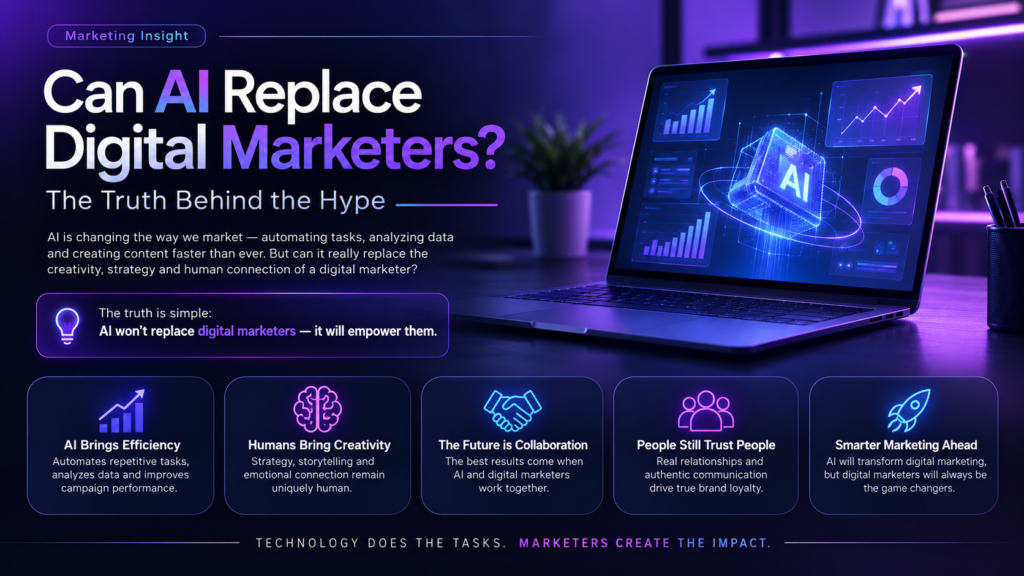
Can AI Digital Marketing Replace Digital Marketers? The Truth Behind the Hype

Artificial intelligence has become one of the most discussed innovations in the digital world. From generating content within seconds to analyzing customer behavior, AI has transformed how businesses approach digital marketing. As a result, many professionals and business owners have started asking a critical question: Can AI Digital Marketing replace digital marketers? The simple answer is no—but it is changing the role of digital marketers forever. While AI can automate repetitive tasks and improve efficiency, it cannot replace human creativity, emotional intelligence, strategic thinking, and authentic communication. Therefore, instead of replacing marketers, AI is becoming a powerful partner that enhances their capabilities. This article explores the reality behind the hype, explains where AI excels, identifies its limitations, and discusses why the future belongs to digital marketers who embrace AI rather than fear it. The Rise of AI Digital Marketing in Digital Marketing Artificial intelligence has rapidly become an essential part of digital marketing. Businesses of all sizes are now using AI tools to automate workflows, personalize customer experiences, optimize campaigns, and improve decision-making. Consequently, companies can save valuable time while achieving better marketing results. Moreover, AI has become increasingly accessible. What was once available only to large enterprises is now within reach of startups, freelancers, and small businesses. Today, marketers use AI for SEO, content marketing, social media marketing, email marketing, PPC advertising, customer service, and predictive analytics. As technology continues to evolve, AI will become even more integrated into everyday marketing activities. Why People Believe AI Will Replace Digital Marketers The growing popularity of AI has created concerns across the marketing industry. Since AI can write blog posts, generate social media captions, design images, create videos, and analyze data within minutes, many believe that human marketers may no longer be necessary. Furthermore, AI-powered platforms continue to improve at an impressive pace. Businesses often see AI as a cost-effective solution because it works around the clock without fatigue. Therefore, some organizations assume they can reduce marketing costs by relying heavily on automation. However, this assumption overlooks one important fact. Content creation and advertising are just two aspects of marketing. Successful digital marketing strategies require creativity, empathy, brand storytelling, market understanding, and strategic planning—qualities that AI cannot genuinely replicate. What AI Does Better Than Humans Artificial intelligence offers several advantages that significantly improve marketing performance. First, AI processes enormous amounts of data much faster than humans. It can identify patterns, predict customer behavior, and provide valuable insights that help businesses make informed decisions. Additionally, AI excels at automation. Tasks such as email scheduling, keyword research, campaign optimization, customer segmentation, chatbot responses, and performance reporting become faster and more accurate. Consequently, marketers can focus on higher-value activities instead of repetitive work. AI also enhances marketing automation by personalizing customer experiences. Recommendation engines, automated emails, and dynamic website content improve customer engagement while increasing conversion rates. Therefore, AI has become an indispensable productivity tool for modern marketers. Where Human Digital Marketers Still Lead Although AI is remarkably intelligent, it lacks genuine human understanding. Digital marketers possess creativity, emotional intelligence, cultural awareness, and critical thinking that machines cannot imitate. These qualities are essential when building meaningful relationships with customers. For example, successful branding depends on storytelling, trust, and emotional connection. A human marketer understands how different audiences react to specific messages because they recognize emotions, social trends, and cultural nuances. AI can generate words, but it cannot truly understand human experiences or emotions. Moreover, experienced marketers make strategic decisions based on business goals, market conditions, competitor analysis, and customer psychology. While AI provides recommendations, humans decide which direction best serves a brand’s long-term vision. The Role of AI in SEO and Content Marketing Search engine optimization has changed dramatically with the introduction of AI. Modern marketers use AI-powered tools for keyword research, competitor analysis, content optimization, technical SEO audits, and search trend analysis. As a result, SEO campaigns become more efficient and data-driven. However, successful content marketing still depends on originality and expertise. Search engines increasingly reward helpful, trustworthy, and people-first content. Therefore, marketers must ensure that AI-generated content is fact-checked, edited, and aligned with the brand’s voice. Furthermore, AI may generate information that sounds convincing but contains inaccuracies. Consequently, human review remains essential to maintain credibility, improve readability, and ensure compliance with search engine guidelines. AI and Social Media Marketing: A Powerful Partnership Social media marketing has benefited significantly from artificial intelligence. AI helps schedule posts, analyze audience engagement, recommend hashtags, monitor trends, and generate creative content ideas. Consequently, marketers can manage multiple platforms more efficiently. Nevertheless, successful social media marketing requires authenticity and timely interaction. Customers expect brands to communicate with empathy, respond appropriately during sensitive situations, and create meaningful conversations. These interactions demand human judgment that AI cannot consistently provide. Additionally, viral campaigns often succeed because they reflect cultural moments, humor, or emotional storytelling. While AI may assist in content creation, human marketers remain responsible for understanding what truly resonates with their audience. The Future of Digital Marketing: Humans and AI Working Together The future of AI in digital marketing is not about competition; instead, it is about collaboration. Businesses that combine AI efficiency with human creativity will achieve the strongest marketing performance. Digital marketers who learn how to use AI effectively will become even more valuable. Rather than spending hours on repetitive tasks, they can dedicate more time to strategy, innovation, customer relationships, and creative campaigns. Consequently, marketing professionals can deliver greater business value while improving productivity. Furthermore, AI will continue evolving. However, every technological advancement will increase the importance of professionals who understand both marketing principles and AI capabilities. Therefore, continuous learning has become essential for every digital marketer. Essential Skills Every Digital Marketer Should Develop As AI transforms the industry, marketers must continuously improve their skills. Learning how to use AI tools is important, but mastering human-centered skills is even more valuable. The most successful digital marketers should focus on: By developing these skills, marketers can remain competitive while maximizing the benefits of artificial intelligence. Common Myths

Scroll to Top